
Wednesday, January 10, 2007

Monday, January 08, 2007
hand: 1-8-07
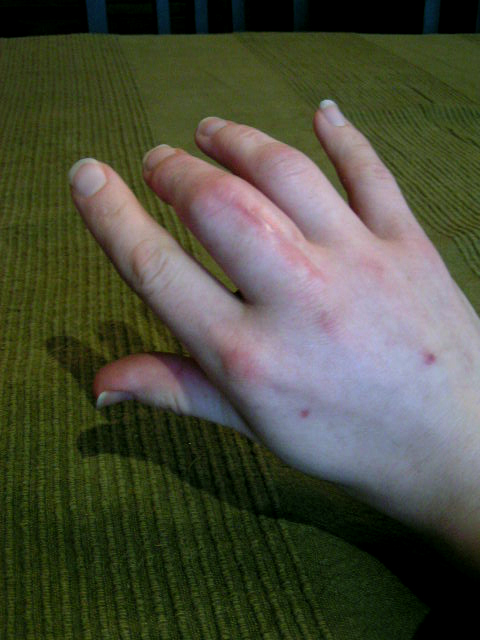 Since the splint was banished last Wednesday I've started using the hand and being fiercer with therapy. It's fantastic to not feel so fragile anymore. At last I can put on a bra by myself. I can carry some things. My body is balancing better for not always keeping my hand protectively close. The downside is that with the middle finger still obstinately sticking out, it looks obscene whatever I do, and it's prone to getting hit with things, which hurts like mad.
There's more improvement in the broken middle metacarpophalangeal joint, but the proximal and distal interphalangeals of that finger are still stubbornly refusing to move. There's all kinds of new feelings going on in unexpected places, the palm, the back of the hand, the wrist. The shedding has stopped, now the skin is super sensitive and raw.

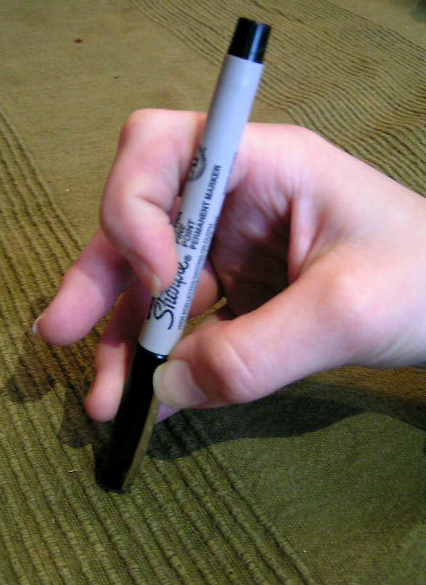 I can grip and pick up light weight objects like a jar, but not small objects like coins. Opening lids is a major hassle, and holding a pencil is not at all effective.
Today it's 7 weeks since the accident. All but the middle finger can now touch the palm (sometimes). My drumming exercise has come a long way.
Sunday, January 07, 2007
pain
 My bones are back together, but the tendons in my fingers and hand are still stuck in scar tissue from the surgery and the fall. I'm working all the time to break them out and thinking about Mo'a's question "Why do these blessings have to come in such a painful way?" Since I got the ok last week to ditch the splint and start using my hand, it hurts more then ever. Physically the healing is more painful then getting injured.
It seems like a fact of nature that growing things comes with discomfort, the birthing of offspring, the pruning of plants, the building of callouses on fiddle fretting fingers, the tearing of muscle to make stronger skating legs. Getting punched, bruised, and slammed in derby showed me how resilient my body is and made me walk braver through other places where I needed it.
And knowing this pain comes from getting better, it's infinitely easier to take. It's funny how that works. It makes me look at all kinds of pain, even the less understandable kinds, in a different way.
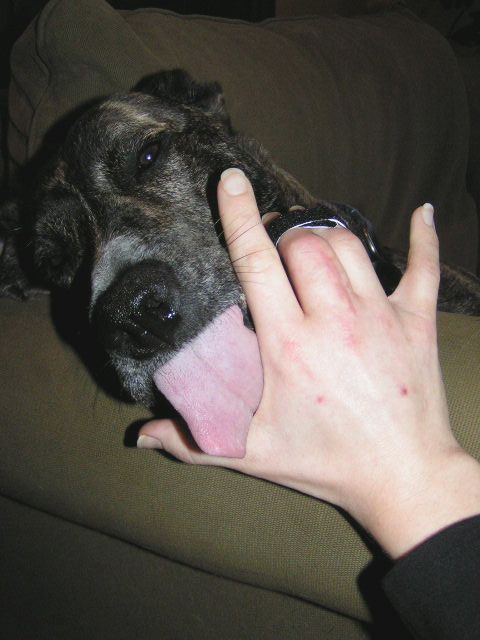
Petula, my sensitive tiger dog, displays compassion.
Thursday, January 04, 2007
mano sinistra
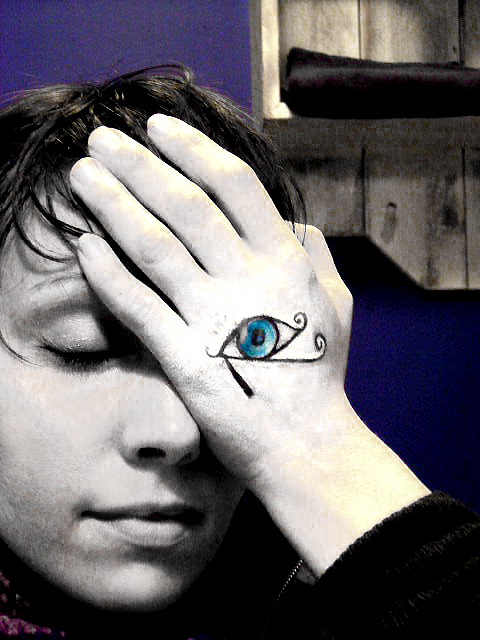 My mum says I wrote with both hands before I broke my left wrist in kindergarten. Then I became a righty. This time has been a shining moment for my overshadowed left hand, which has performed honorably in picking up the slack of my right. There's not too much it can't do.
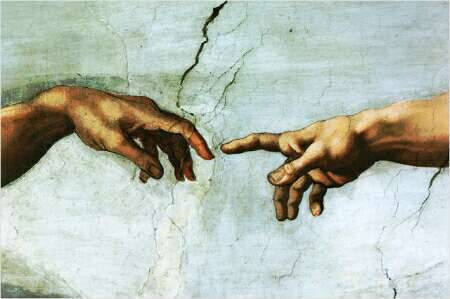
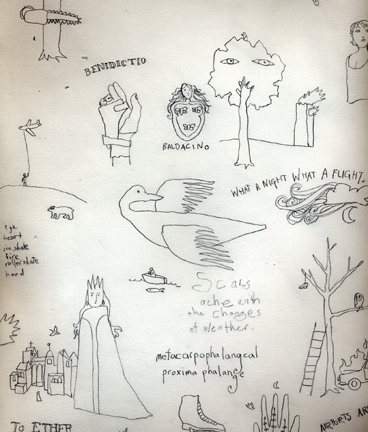
Drawing with my left has been more fun then drawing has been in a while. There's a bigger element of surprise in what might come out on paper. And as it's gotten steadier I'm beginning to recognize my regular righty style coming out, which makes me realize my art does come more from the head then the hand.
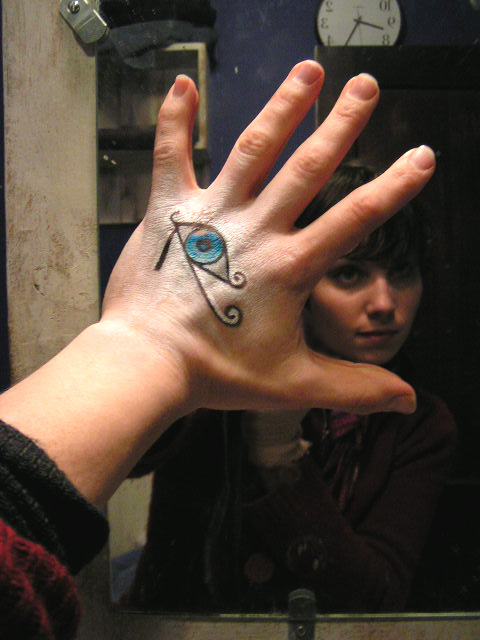
And though typing is still a chore, I've figured out how to take pictures with my right hand while my left is 100% proficient with a mouse. So I entertain myself with Photoshop.
Tuesday, January 02, 2007
the patient of saints
 I'm the kind of person you have to trick or ambush to get into any kind of medical facility, but everyone at the Center for Orthopaedics is so terrific that it's actually quite pleasant. Maybe I'll even lose a phobia or two.
Dr. Mark Altman, hand surgeon, a genius, and so extrordinarily calm and assuring. The only doctor who's succeeded in putting me at ease which is a miracle. And he does brilliant work. He is awesome.
Lisa Cyr, occupational therapist, hand therapist. The first day I saw her right after they'd pulled out my pins her kindness, patience and optimism kept me from passing out. Another miracle. Therapy appointments are something I look forward to because of her. And she's got my hand starting to work again.
Margaret Carl, nurse and stage manager, who hooked me up with these hand fixers, went out of her way to be with me at every doctor visit, and has been my mentor and supporter even at the same time as running our Christmas show. She's been a savior for Karl and me and our theater company for a long time, and is the one who brought me into Puppetsweat and the Quarry, which are other great stories for another time. Margaret is the ultimate miracle worker.
Mike, my therapy partner, a right handed young artist and tree cutter, who damaged his right hand falling out of a tree with a chainsaw a week or so before my accident. His amazing light hearted spirit, humor and encouragement has been an inspiration.
I am a very, very lucky bird.
Monday, January 01, 2007
change of direction
 Before roller derby interrupted, I was working at reversing my figure skating spin. In ice skating you can do your jumps and spins clockwise or counterclockwise. Counterclockwise is as common as right handedness, but either way you do both in the same direction.
I developed split direction early on, I jumped counterclockwise and spinned clockwise. A major flaw. A few years ago I set on teaching myself the other direction. It's not easy to switch. It made me nauseous a lot and my spins would travel 10 or 15 feet. I read about the clockwise-turning whirling dervishes so I tried pretending to be a dervish and imagined myself as the axis of the universe. It became the best sort of meditation and an enjoyable daily ritual of sorts. After 2 years I finally got a pretty good counterclockwise spin going, a dozen times better then my clockwise ever was.
Sunday, December 31, 2006
parallels
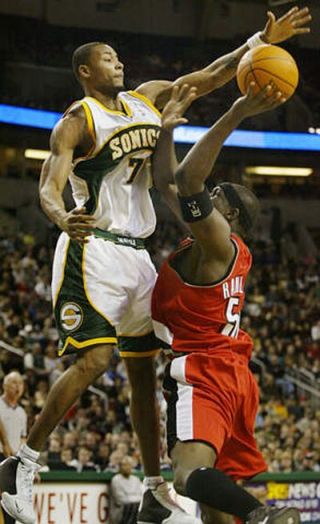
player: Rashard Lewis, a top point scorer
team: Seattle SuperSonics, the struggling underdogs
injury: December 20, torn right hand
surgery: December 22
prognosis: out of play for months
Rashard Lewis wore a gauze wrap under black Velcro straps. Those are keeping him from moving his surgically repaired hand. That's not all Lewis wants immobilized. Even though he is likely to miss the next two months, the SuperSonics' second-leading scorer wants his team to keep him from moving elsewhere in free agency after this season. "I'm pretty confident I will be a Sonic for a while. I want to be a Sonic," Lewis said. Lewis talked before his team hosted New Orleans on Tuesday night, his first public words since surgery last Friday stitched tendons back together in his right hand. "Obviously, this is a setback for me," Lewis said. Then he smiled."Maybe it will make me a better player – I'll just work on my left hand and hopefully I can come back a better player."
Sportsline
player: Polly Sonic, a top point scorer
team: Iron Angels, the struggling underdogs
injury: November 20, broken right hand
surgery: November 22
prognosis: out of play for months
Titillation aside, there are real injuries. When her alter ego Polly Sonic broke bones in her right hand in preparation for the bout, Wingerter, a children's illustrator, had a hard time explaining it to her agent. The pins come out this week, and it will take another month or two to heal, but the roller girl just regretted sitting out the first event.
Wingerter, 34, is a former figure skater who felt she never fit in until she found the derby.
"The second I got out there, it was scary, but I've never been so in the moment skating," Wingerter said. "I was like, this was it."
The Journal News
Saturday, December 30, 2006
regeneration
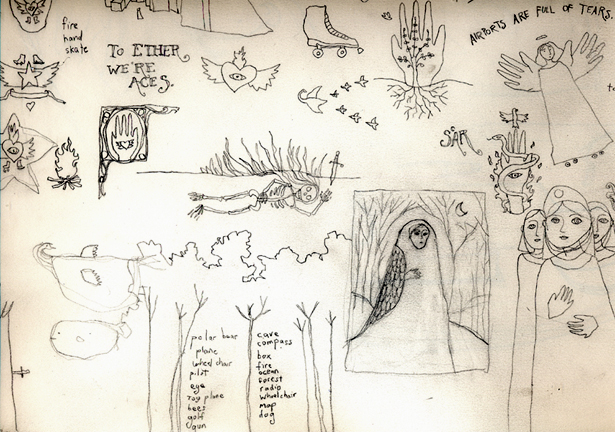 Mysterious behavioral changes of the last 5 weeks: the tendancy to fall asleep anywhere at anytime, intense introversion, an appetite for all kinds of meat, comfort with poor hygiene and a loss of vanity, a keen interest in anatomy and medical procedures, anxiety about physical safety, an aversion to travel and the outside world, an attraction to mainstream team sports, and the desire to speak as little as possible.
My hand has been shedding skin like a snake. I'm fascinated by the endless layers falling off the soft new skin underneath. Mortified at first with the idea of cadaver bone used to fill in my missing pieces, Margaret assured me my own bone will grow and eventually replace the graft with entirely new material. My therapy is building new muscle. My hand is essentially regenerating itself, and probably all the sleeping, meat eating and energy-conserving solitude has been to assist that.
Maybe there's more then bones being restored. 3 minutes after I fell my brain was refocusing everything. It's weird to find out how mutable we are, how quickly we can shift and adapt. Whatever else is shed and regrown is bound to be as quirky as these left handed drawings.
Friday, December 29, 2006
broccoli
 I've got a recipe in a cookbook that's just come out by Sharron McElmeel. It's the dish you've had if you've been to my house because it's the only one I make. I wrote it so long ago I forgot that the link between art and survival, in my case, is broccoli.
Thursday, December 28, 2006
all hands on deck
 Steve posted this in a comment below:
My Great Grandma used to tell me a story from her youth, about a boy in her hometown who was posessed by the devil. He used to walk on the roofs of houses at night. Eventually, the devil was exorcised and burst out the tip of his pinkie finger.
That is so cool and I want more. I'm looking for hand stories of all kinds. Injuries, myths, theories, beliefs, quotes, facts, drawings, etc. Post in the comments, or email to me at merfire at gmail.com.
Meanwhile enjoy painted hands from all over the world like this one at the Hand Collector Gallery.
Wednesday, December 27, 2006
lentils
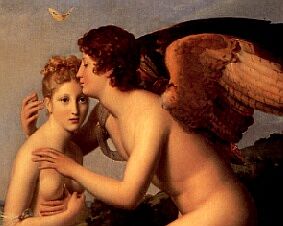 A myth:
Psyche was a princess and so beautiful that the people began to worship her instead of Venus, which pissed off Venus. She sent her mischievous son, Eros, to make Psyche fall in love with something hideous as punishment. But Eros, surprised by her beauty while piercing her with his arrow, accidentally pierced himself too. He married her and took her to his palace on a mountain with the condition she never look at him. Psyche's unfriendly sisters convinced her he must be a monster and in the night as he slept she bent over him with a lamp and found he was a beautiful winged boy. But a drop of hot oil fell and woke him. Injured and furious with her betrayal he abandoned her. Psyche grieved and appealed to Venus, who gave her a series of chores to accomplish before leading her back to Eros, the first of which was to separate a mountain of lentils into piles in one night.
My latest therapy game is to pick up handfulls of dry pinto beans from one bowl and move them to another. At first I could only hold a couple which more or less just got stuck to the sweat of my skin from the effort. Now I'm able to grasp a pretty good pile. Next I'll graduate to split peas, then to rice.
A whole lot of fairy tales evolved out of Eros and Psyche and retain the lentils, like East of the Sun West of the Moon and Cinderella. Psyche finishes her impossible task with the help of an army of ants, Cinderella gets birds from her mothers tree. I'm not seeing any ants or birds lately, but the monotany of lentil picking has been majorly relieved by the full set of Lost dvds Eliza B loaned me. Thank god for you, Eliza B.

Tuesday, December 26, 2006
hand: 12-26-06
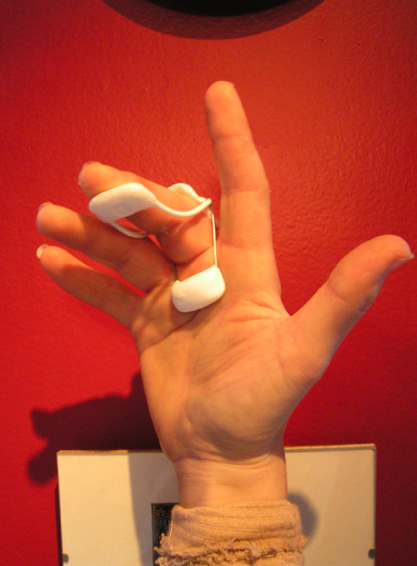 My middle metacarpophalangeal joint, the one that connects the finger to the hand which broke, is moving relatively well while curiously the other two joints of that finger are still nearly totally unmovable and stuck in a bent position. I wear this little torture device, a spring splint, which applies constant pressure to push it straight.
But all the other fingers are able to move much quicker now. My best fist and straight hand two weeks into therapy. The pinky is finally able to touch the palm by itself.
handedness
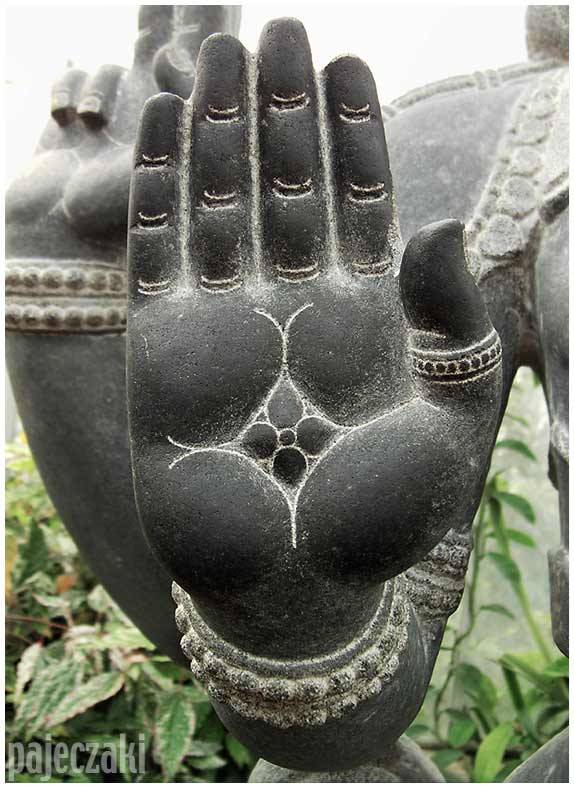 Handedness is an attribute of human beings defined by their unequal distribution of fine motor skill between the left and right. An individual who is more dextrous with the right hand is called right-handed, and one who is more skilled with the left is said to be left-handed. A minority of people are equally skilled with both hands, and are termed ambidextrous. People who demonstrate awkwardness with both hands are said to be ambilevous or ambisinister. There are four main types of handedness:
Right-handedness is the most common. Right-handed people are more dextrous with their right hands when performing a task.
Left-handedness is less common than right-handedness. Left-handed people are more dextrous with their left hands when performing a task. About 17% of people are lefthanded.
Mixed-handedness, also known as cross-dominance, is being able to do different tasks better with different hands. For example, mixed-handed persons might write better with their right hand but throw a ball more efficiently with their left hand. This could also refer to pianists, because different sections of pieces are usually composed to fit the abilities of the different hands, considering that the right hand is usually for melodies and the left-hand, harmonies. However, some people often refer to handedness as the hand that a person uses to write, so this form of handedness is not usually referred to.
Ambidexterity is extremely rare. A true ambidextrous person is able to do any task equally well with either hand. The condition is very rare, although it can be learned (those who master it still tend to sway towards their originally dominant hand.
Most humans that are right-handed prefer to draw their circles and stir beverages counter-clockwise. Laterality in animals is also called limb dominance. Most race tracks are run counter-clockwise, which favors right-side dominant horses, as they take a longer stride with the right foreleg, which helps them turn to the left. Trainers of left eye dominant horses may put a blinder on the left eye to encourage the horse to turn the head slightly to the left and to take a longer step with the right foreleg just as right-side dominant horses do. Parrots tend to favor one foot when grasping objects (for example fruit when feeding). Some studies indicate that most parrots are left footed. Polar bears generally kill their prey using their left paw.
Monday, December 25, 2006
touch
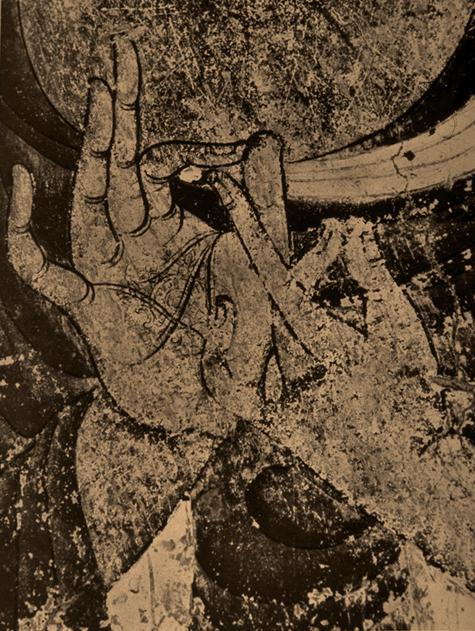 According to the craftsmen of the Middle Ages, that's why we have spiral patterns on our fingertips. They thought the whorls there are marks left by the soul entering or leaving the body. In this imaginative way of thinking, we infuse the people and things we touch in the world with soul by the care and attention of our touch. Our soul emerges from this mysterious place inside us and out through our fingertips, ensouling the wood we carve, the gardens we cultivate, the children and animals and lovers we touch. To me, this is a poetic way of imagining how we bring soul back into our personal lives—by paying attention to the very way we touch, as with the way we prepare food or the care we give our work or the manner in which we touch the earth.
Tuesday, December 19, 2006
Frida Kahlo
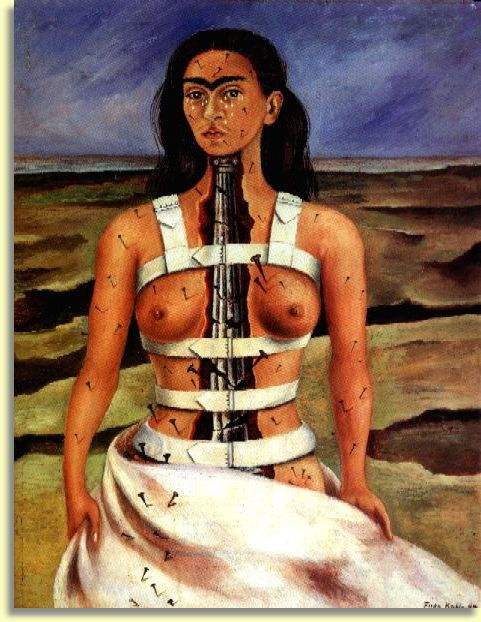 Frida suffered a bout of polio at age six, which left her right leg looking much thinner than the other (a deformity Kahlo hid by wearing long skirts). Nevertheless, Frida's feisty personality as well as her father's encouragement led to her participation in boxing and other "manly" sports, which helped her overcome her disability.
In 1925, when she was 18, she was riding a bus in Mexico City when it was struck by a trolley car. A metal handrail pierced her abdomen, exiting through her vagina. Her spinal column was broken in three places. Her collarbone, some ribs, and her pelvis were broken, and her right leg was fractured in 11 places. Her foot was dislocated and crushed. No one thought she would live, much less walk again, but, after a month in the hospital, she went home. Encased for months in plaster body casts, Kahlo began to paint lying in bed with a special easel rigged up by her mother. With the help of a mirror, Kahlo began painting her trademark subject: herself. Of the 150 or so of her works that have survived, most are self-portraits. As she later said, "I paint myself because I am so often alone, because I am the subject I know best."
Django Reinhardt
 A google image search for "injured hand" was more than enough to stop my complaining. And it brought up some good stories.
At the age of 18, Django Reinhardt was injured in a fire that ravaged the caravan he shared with Bella, his first wife. She made imitation flowers out of celluloid and paper for her living. Consequently, their home was full of the highly flammable material. Returning from a performance late one night, Django allegedly knocked over a candle on his way to bed. While his family and neighbors were quick to pull him to safety, he received first and second degree burns over half his body. His right leg was paralyzed, and his left, or fretting, hand was badly burnt.
There followed a long period of terrible suffering. For a year and a half Django was bedridden and became increasingly frantic not about the serious condition of his leg but about the hand which refused to heal, threatening to put an untimely end to his musical ambitions. Whenever his mother who never left his bedside, asked him “What are thinking about, Django?“ he would reply, “My hand.” Seeing this, his young brother brought him, some time later, a brand new guitar in an oilcloth case and with this the injured man began an astonishing programme of self-reeducation which left the staff of the St-Louis Hospital gasping. By long, painful and lonely exercise the young guitarist succeeded, against all expectation, in overcoming his terrible handicap and inventing an instrumental technique that was entirely his own.
Monday, December 18, 2006
anatomy
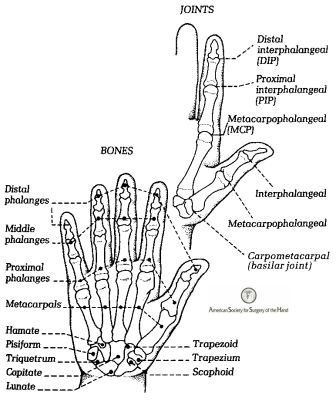 There are 19 bones in the hand. There are 5 metacarpal bones and 14 phalangeal bones. The metacarpal bones are located in the palm. There is one for each of the fingers and one for the thumb. The phalangeal bones are small, slender bones located in the fingers and in the thumb. There are 3 phalangeal bones in each finger and 2 in the thumb.
 The fingers and thumb are often referred to collectively as the "digits". There are 14 small joints in the hand that allow for movement of the digits. The metacarpophalangeal (MCP) joints are the joints that allow for movement between the palm and each of the digits. The interphalangeal (IP) joints are the smaller joints between the phalangeal bones of each digit. The thumb has one IP joint and each finger has two.
Ligaments are like strong ropes that connect bones and provide stability to joints. In the hand there are numerous ligaments that stabilize the MCP and the IP joints. These ligaments are located on the top (dorsal), bottom (palmar), inner (medial) and outer (lateral) aspects of these joints. There are other ligaments in the palm that work in conjunction with a thick tissue located in the palm (the palmar aponeurosis) to provide stability to the metacarpal bones.
Tendons connect muscles to bone. Many of the muscles that move the fingers and thumb originate from the elbow. The tendons of these muscles cross the wrist and attach to the bones of the hand. The large muscles that bend (flex) the fingers originate from the medial aspect of the elbow. The large muscles that straighten (extend) the fingers originate from the lateral aspect of the elbow. In addition to these large muscles, there are smaller muscles in the hand that flex, extend, abduct (move outwards) and adduct (move inwards) the fingers.
Finally, the median and ulnar nerves are the major nerves of the hand. These nerves begin in the neck, run the length of the arm and into the hand. These nerves transmit electrical impulses to and from the brain to move and provide feeling to the hand.
Sunday, December 17, 2006
pieta
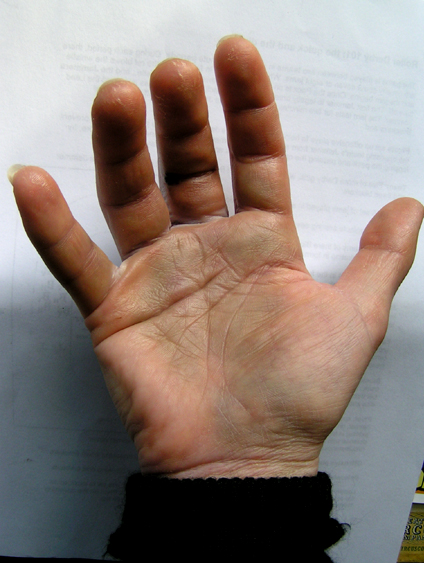 It was easy to let other people take care of my hand in the first three weeks. The hideousness of it was safely concealed beneath a cast and pain killers. I refrained from looking at it or the xrays at my doctor visits. Now I have to remove the splint 6 times a day and manipulate it on my own. At the physical therapy office, surrounded by others in worse states of disrepair, and coached by an encouraging therapist, I'm a trooper. But alone with my sad hand, which feels like some foreign inanimate object transplanted at the end of my arm, I am prone to the most unbelievable pathetic bouts of weeping and self pity.
While I follow the prescribed excersizes it's clear how much the essence of my entire life, being, identity, and self worth has pivoted on my hands. In the context of me as an illustrator, puppeteer, fire dancer, doll maker, and artist, what I did, the risk I took, the mistake I made, was abominably stupid. My self is more in my right hand then in my heart or my head, and here I am, pretty much useless.
And I'm unexpectedly wishing to avoid the therapy. I try distractions to make it easier: music, tv, friends, wine, books, meditation, pets. But so far nothing works, so I shut myself up and indulge in outrageous pathos for the half hour that I warm and stretch my hand. I'm sure I'll eventually get used to it but for now my melodramatic side is winning out.
Photo: the hand today. Bruise fading, strange hard thickness of skin on palm and fingers persisting. I can make a better fist now.
Friday, December 15, 2006
casts
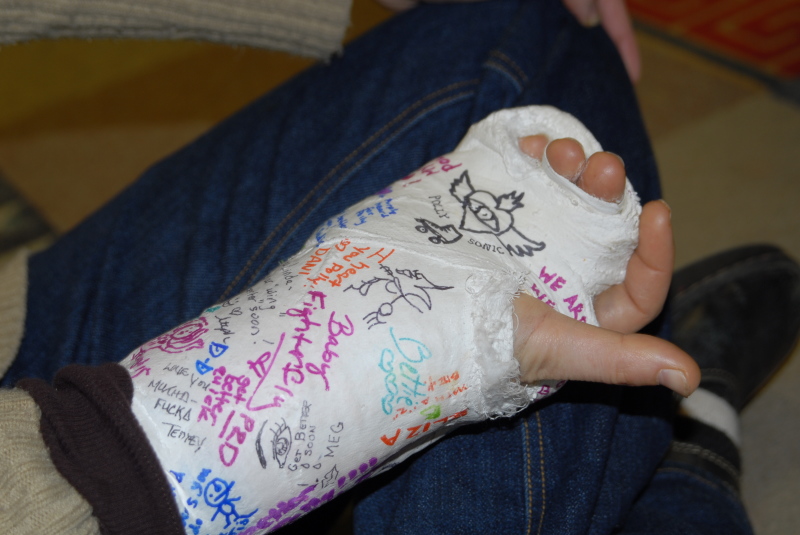
 This is the custom fitted plastic splint I'm wearing now. I've had 3 other hand imobilization apparatuses: the understated fiberglass forearm splint I sported at the bout, the flashy and massive post-surgery plaster cast, and the makeshift splint from the emergency room I was too traumatized to get any pictures of.
It's taken some getting used to my wrist being free for the first time in 3 weeks, and to my hand being this exposed. I also don't get nearly as much sympathy as I did from strangers.

Subscribe to:
Posts (Atom)